| HIRANUMA APPLICATION DATA | Automatic Titrator | Data No. | O1 | Feb. 03,2022 |
| Factor standardization | Standardization of hydrochloric acid titrant |
1. Abstract
The measurement method of alkaline substance by neutralization titration using a hydrochloric acid standard solution is widely used in the titration analysis. Factors are indicated on the commercially available standard solution for volumetric analysis. The factor determination is required when the standard solutions are prepared in the laboratory. Also it is effective to check the repeatability by the factor measurement using a standard material to check the performance of titrator system. Japanese Industrial Standard JIS K 8001 and the Japanese Pharmacopoeia describe that sodium carbonate, which is a standard material for a volumetric analysis, should be used for the factor determination of hydrochloric acid standard solution.
In this report, sodium carbonate, which is a standard material, was dissolved in pure water, and potentiometric titration was performed with 0.1 mol/L hydrochloric acid standard solution to determine the factor. 1 mol of sodium carbonate and 2 mol of hydrochloric acid react quantitatively according to Eq. (1) and (2), and the titration curve shows two inflection points. The first and second inflection points appear at the alkaline pH and the acidic pH, respectively. In this report, the end point of the titration is defined as the equivalent point in Eq. (2), thus the second inflection point is detected as the end point.
| Na2CO3 + HCl → NaHCO3 + NaCl ・・・(1) NaHCO3 + HCl → NaCl + CO2 + H2O・・・(2) |
1) Japanese Pharmacopoeia Eighteenth Edition
2) Japanese Industrial Standard JIS K8001 General rules for test methods of reagents
2. Configuration of instruments and Reagents
| (1) | Configuration of instruments | ||
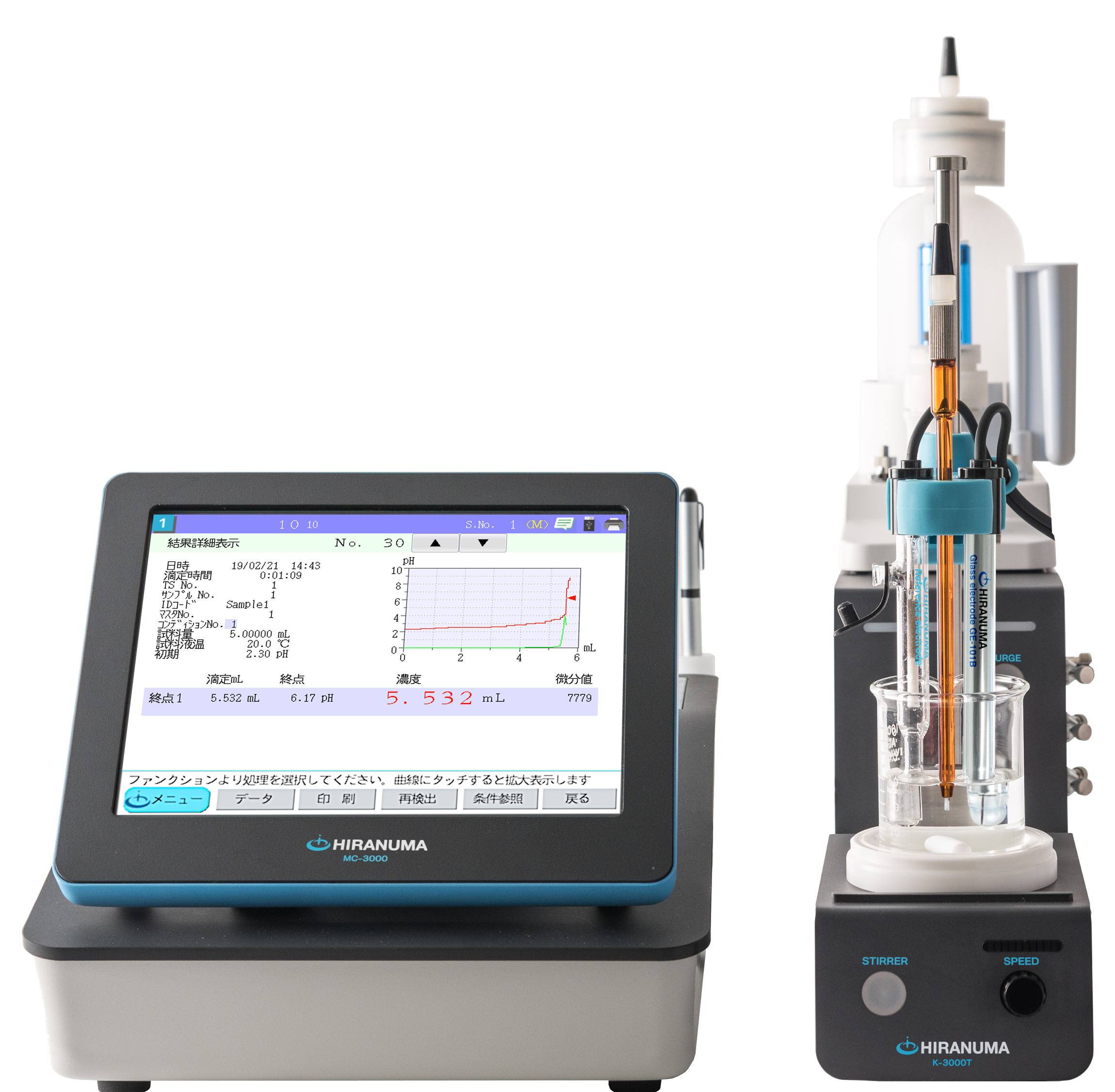
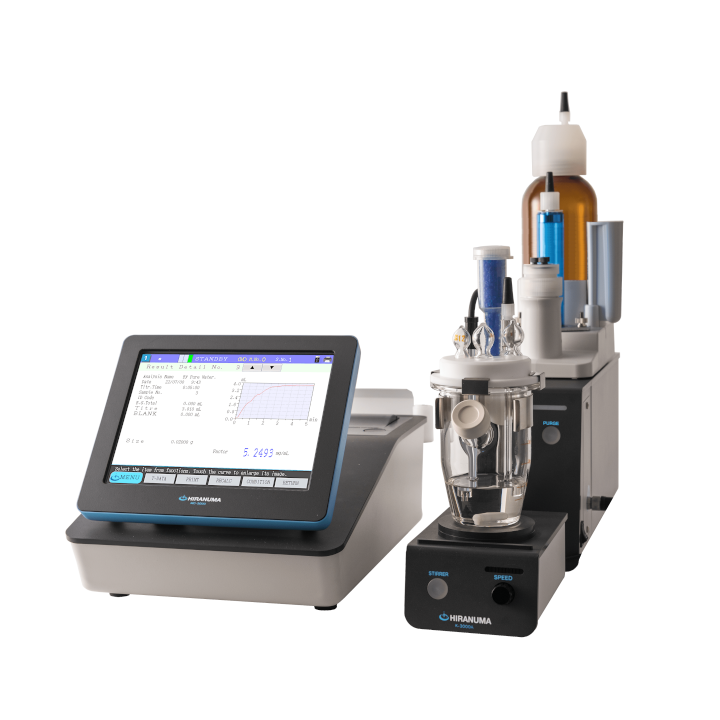
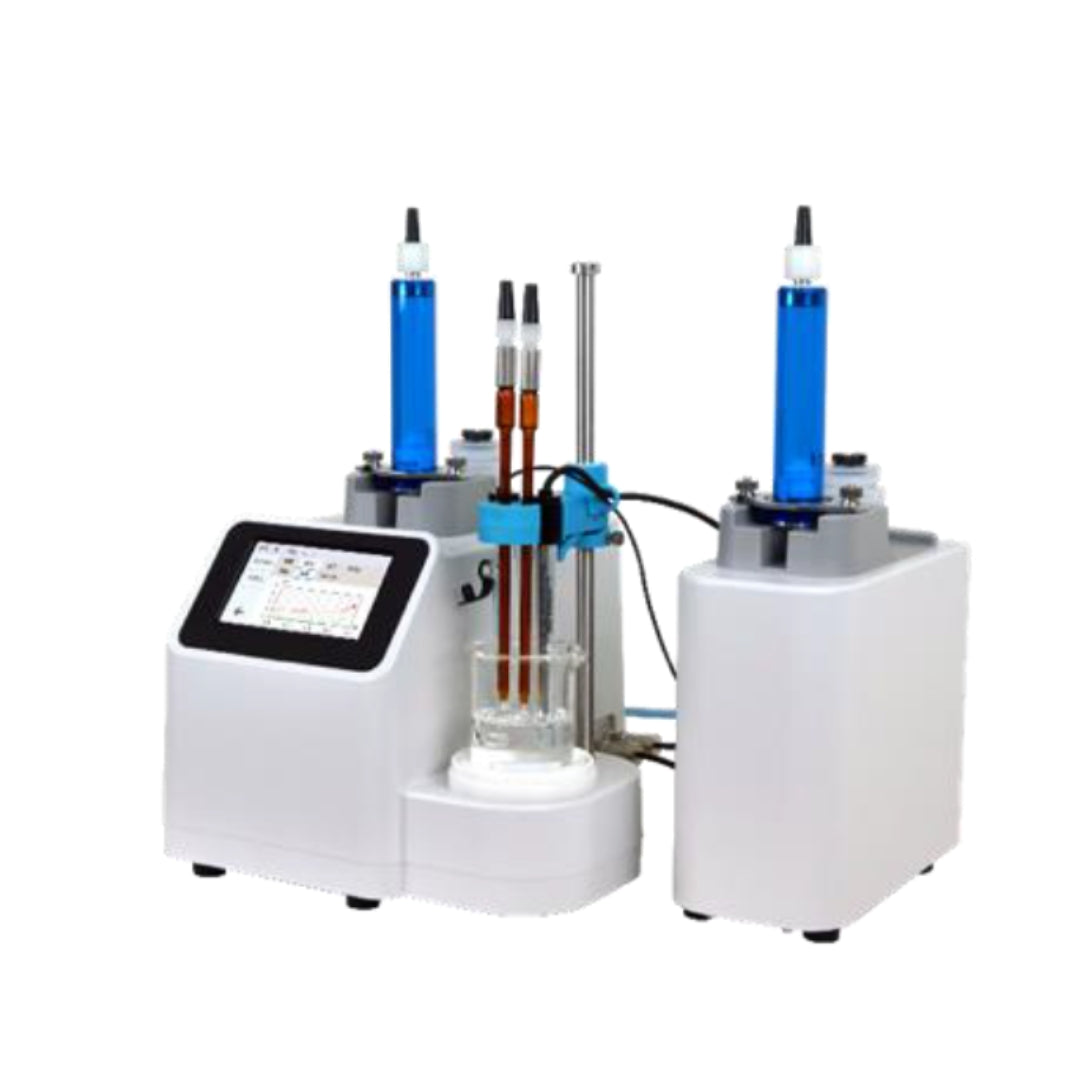
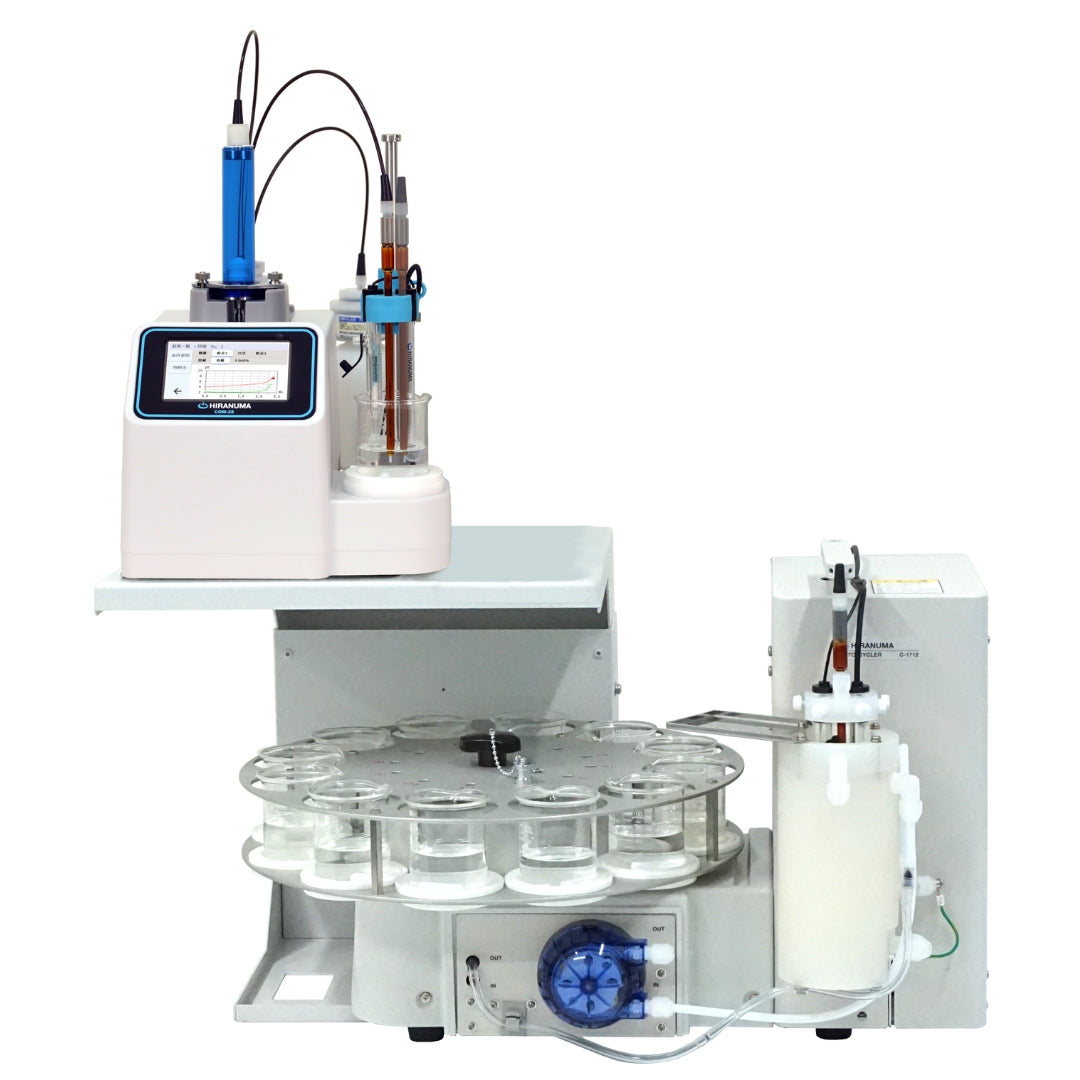
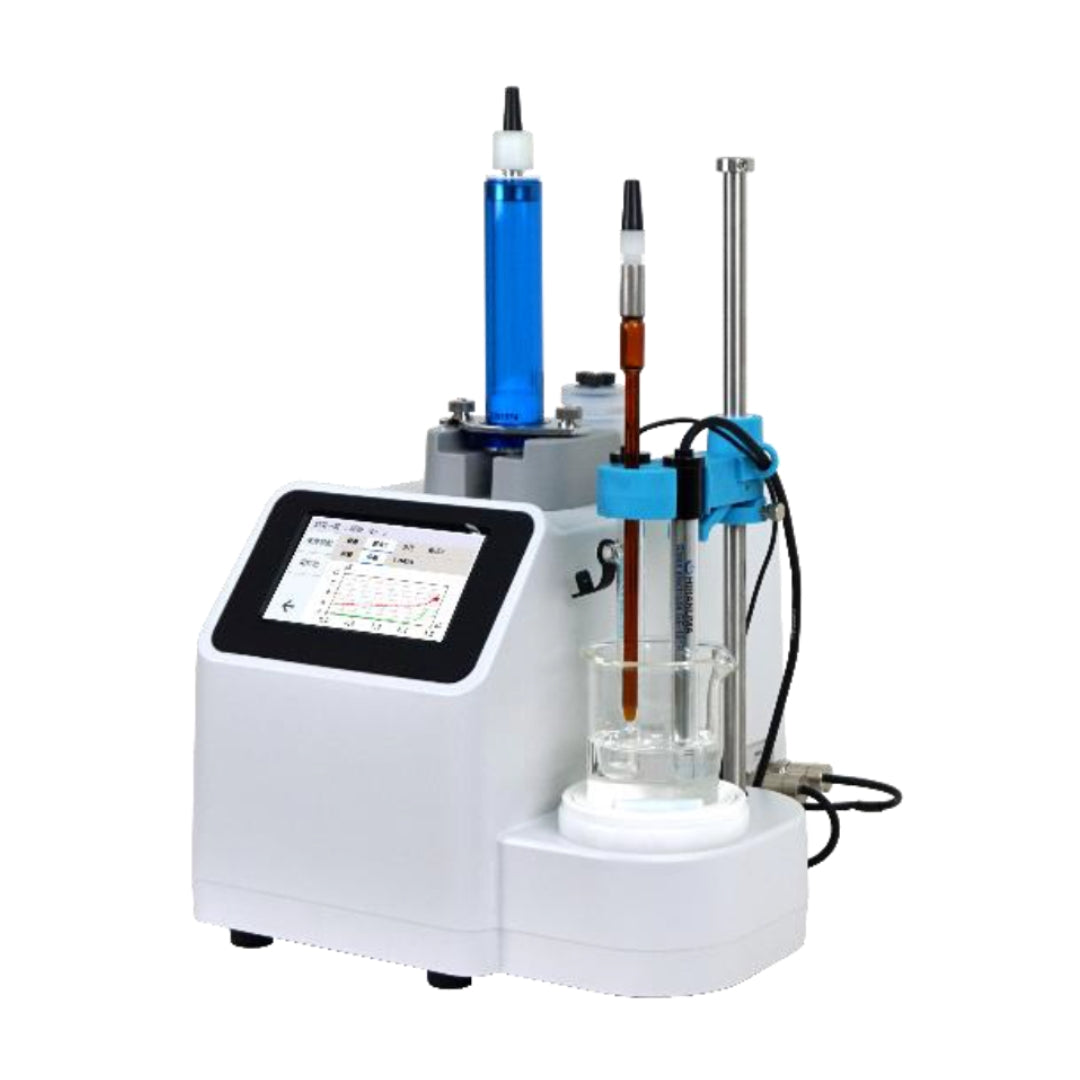
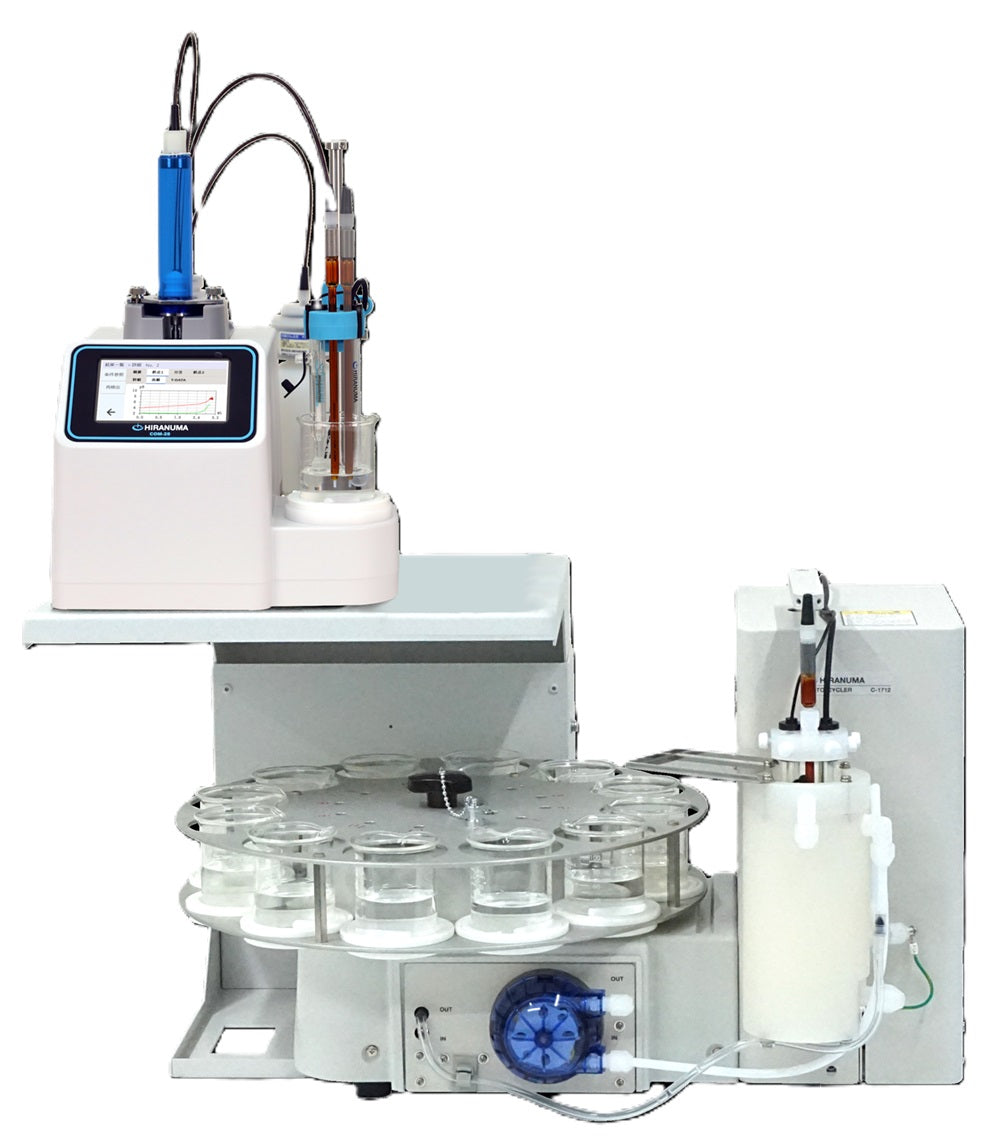
| Main unit | : | Automatic Titrator COM Series | |
| Electrodes | : | Glass electrode GE-101B Reference electrode RE-201Z |
|
| (2) | Reagents | ||
| Titrant | : | 0.1 mol/L (0.1 N) hydrochloric acid standard solution (Buret No. 1) | |
| Standard material | : | Sodium carbonate, standard material for volumetric analysis (Certified value of purity in this report: 100.00 %) |
|
3. Measurement procedure
| (1) | Take about 0.15 g of sodium carbonate into a 100 mL beaker and weigh it accurately to 0.1 mg digits. |
| (2) | Add 50 mL of DI water and a stirrer bar to the 100 mL beaker to dissolve the sample. |
| (3) | Immerse the electrodes and start the measurement. Titration is performed with a 0.1 mol/L hydrochloric acid standard solution, and the second inflection point on the titration curve is detected as the end point. The parameter setting which does not detect the first inflection point is explained in Section 5. |
| (4) | Perform the blank test with the same procedure of sample measurement. |
4. Measurement conditions and results
Examples of titration conditions
Blank measurement
| Cndt No. | 1 | |
| Method | Auto | |
| Buret No. | 1 | |
| Amp No. | 1 | |
| D. Unit | pH | |
| S-Timer | 20 | sec |
| C.P. mL | 0 | mL |
| T Timer | 0 | sec |
| D.P. mL | 0 | mL |
| End Sens | 300 | |
| Over mL | 0.3 | mL |
| Max Vol. | 1 | mL |
| Constant No. | 1 | |
| Size | 0 | g |
| Blank | 0 | mL |
| Molarity | 0.1 | mol/L |
| Factor | 1 | |
| K | 0 | |
| L | 0 | |
| Unit | mL | |
| Formula | D | |
| Digits | 3 |
| Mode No. | 16 | *1 |
| Pre Int | 0 | sec |
| Del K | 0 | |
| Del Sens | 0 | mV |
| Int Time | 3 | sec |
| Int Sens | 3 | mV |
| Brt Speed | 2 | |
| Pulse | 16 | |
*1: Since the maximum change in electrode potential is shown at the first drop of this blank titration, the end point is detected in the first drop or less volume. To detect this maximum change as an end point, set Mode No. to which the blank mode function is assigned, Mode No.12-19 for COM-A19.
Factor standardization measurement with sodium carbonate
| Cndt No. | 2 | |
| Method | Auto | |
| Buret No. | 1 | |
| Amp No. | 1 | |
| D. Unit | pH | |
| S-Timer | 20 | sec |
| C.P. mL | 20 | mL |
| T Timer | 20 | sec |
| D.P. mL | 0.5 | mL |
| End Sens | 300 | |
| Over mL | 0.5 | mL |
| Max Vol. | 40 | mL |
| Constant No. | 2 | |
| Size | 0 | g |
| Blank | 0.01 | mL |
| Molarity | 0.1 | mol/L |
| Factor | 1.0000 | *2 |
| K | 52.995 | *3 |
| L | 0 | |
| Unit | Fact2 | |
| Formula | ||
| S*F*1000/(K*M*(D-B)) | ||
| Digits | 4 |
| Mode No. | 4 | |
| Pre Int | 0 | sec |
| Del K | 9 | |
| Del Sens | 0 | mV |
| Int Time | 3 | sec |
| Int Sens | 3 | mV |
| Brt Speed | 2 | |
| Pulse | 40 | |
*2: Purity of sodium carbonate / 100
*3: It is the mass (g) of sodium carbonate that reacts with 1 mol of hydrochloric acid by the reaction formula (1) and (2), which is a half value of the formula amount (105.99) of sodium carbonate.
Measurement results
Results of factor standardization measurement
| Sample | Measurement No. |
Sample Size(g) |
Titrant volume (mL) |
Factor | Statistical results |
|
|---|---|---|---|---|---|---|
| Blank | 1 | – | 0.010 | – | Avg. | 0.01 mL |
| 2 | – | 0.010 | – | |||
| 3 | – | 0.010 | – | |||
| Sodium carbonate | 1 | 0.1482 | 27.684 | 1.0105 | Avg. | 1.010 |
| 2 | 0.1486 | 27.765 | 1.0103 | SD | 0.001 | |
| 3 | 0.1646 | 30.825 | 1.0079 | RSD | 0.14 % | |
-

Blank measurement
-

Factor standardization measurement
Examples of measurement curves
5. Note
(1) Setting of measurement condition parameters
The neutralization reaction of sodium carbonate proceeds in two steps as shown in the reaction formulas (1) and (2). If titration is performed while dynamic controlling of the increment volume from the start of measurement, two inflection points can appear as shown in the below figure. To detect the second inflection point as the end point, it is necessary to set not to detect the first inflection point. In this report, the parameter “CP mL” is set, and the amount of titrant that exceeds the first inflection point is dispensed at the start of measurement, and then titration is performed with dynamic controlling of the increment volume to detect the second inflection point. The 20 mL set for the parameter “CP mL” was determined by the known reaction ratios of hydrochloric acid to sodium carbonate and preliminary tests shown below.
1 mL of 0.1 mol/L hydrochloric acid = 5.2995 mg of sodium carbonate
From this reaction ratio, 0.15 g of sodium carbonate consumes about 28 mL of the titrant until the second inflection point, and since the first inflection point appear at a half of that titrant volume, it can be expected to be about 14 mL.
The set value for the parameter “CP mL” can be set to about 2 mL before the end point (26 mL in this case), but it was set to 20 mL in consideration of fluctuations in the sampling weight.
Otherwise, to prevent the detection of the first inflection point as the end point while keeping two inflection points on the titration curve as shown in the figure below, the parameter “DP mL” is set to 20 mL for instead of “CP mL”. Even if an inflection appears, it will not be detected as the end point until the titration volume exceeds the parameter “DP mL” set value.

Titration curve showing two inflection points with setting “DP mL” to 20 mL
(2) About the effect of the parameter “CP mL”
The parameter “CP mL” has the effect of shortening the measurement time. In this case, the measurement time was 9 to 10 minutes when the “CP mL” was not used, whereas it was 5 to 6 minutes when it was set to 20 mL. In addition, this sample solution at the start of measurement is strongly alkaline and it tend to absorbs carbon dioxide in the air to generate sodium carbonate, which can cause variations in neutralization titration. By using the parameter “CP mL”, the strongly alkaline sample at the start of measurement is quickly brought to neutral pH, which leads to improvement in repeatability.
Keywords: Factor standardization, Neutralization titration, Hydrochloric acid, Sodium carbonate
*Depend on the configuration of instrument, ,some of measurement may not possible