| HIRANUMA APPLICATION DATA | Automatic Titrator | Data No. | J6 | Apr. 5,2019 |
| Inorganic acids & Mixed acids | Fractional determination of nitric acid and acetic acid |
1. Abstract
The mixed solution of nitric acid (inorganic acid) and acetic acid (organic acid) works as strong acid, and also has the strong oxidizable ability and solvency. It is used as the surface treatment solution for metals, glass products, and semiconductors.
Mixed acid solutions containing nitric acid and acetic acid are widely used in industrial and semiconductor processing.
Accurate determination of each component is essential for process control, product quality, and chemical balance.
Potentiometric titration enables fractional determination, allowing both acids to be quantified in a single analysis based on separate equivalence points.
This report introduces an example of the fractional and successive determination for nitric acid and acetic acid by neutralization titration with sodium hydroxide standard solution.
| HNO₃ + NaOH → NaNO₃ + H₂O | ・・・(1) |
| CH₃COOH + NaOH → CH₃COONa + H₂O | ・・・(2) |
Principle of Fractional Determination
In a mixed acid system, nitric acid (strong acid) reacts first during titration, followed by acetic acid (weak acid).
This results in two distinct equivalence points:
- First endpoint → nitric acid
- Second endpoint → acetic acid
By measuring the titrant volume at each endpoint, the concentration of each acid can be calculated independently.
Typical Applications
- Metal surface treatment solutions
- Semiconductor chemical processing
- Glass and materials treatment
- Industrial acid mixtures
- Chemical manufacturing
2. Configuration of instruments and Reagents
| (1) | Configuration of instruments | ||
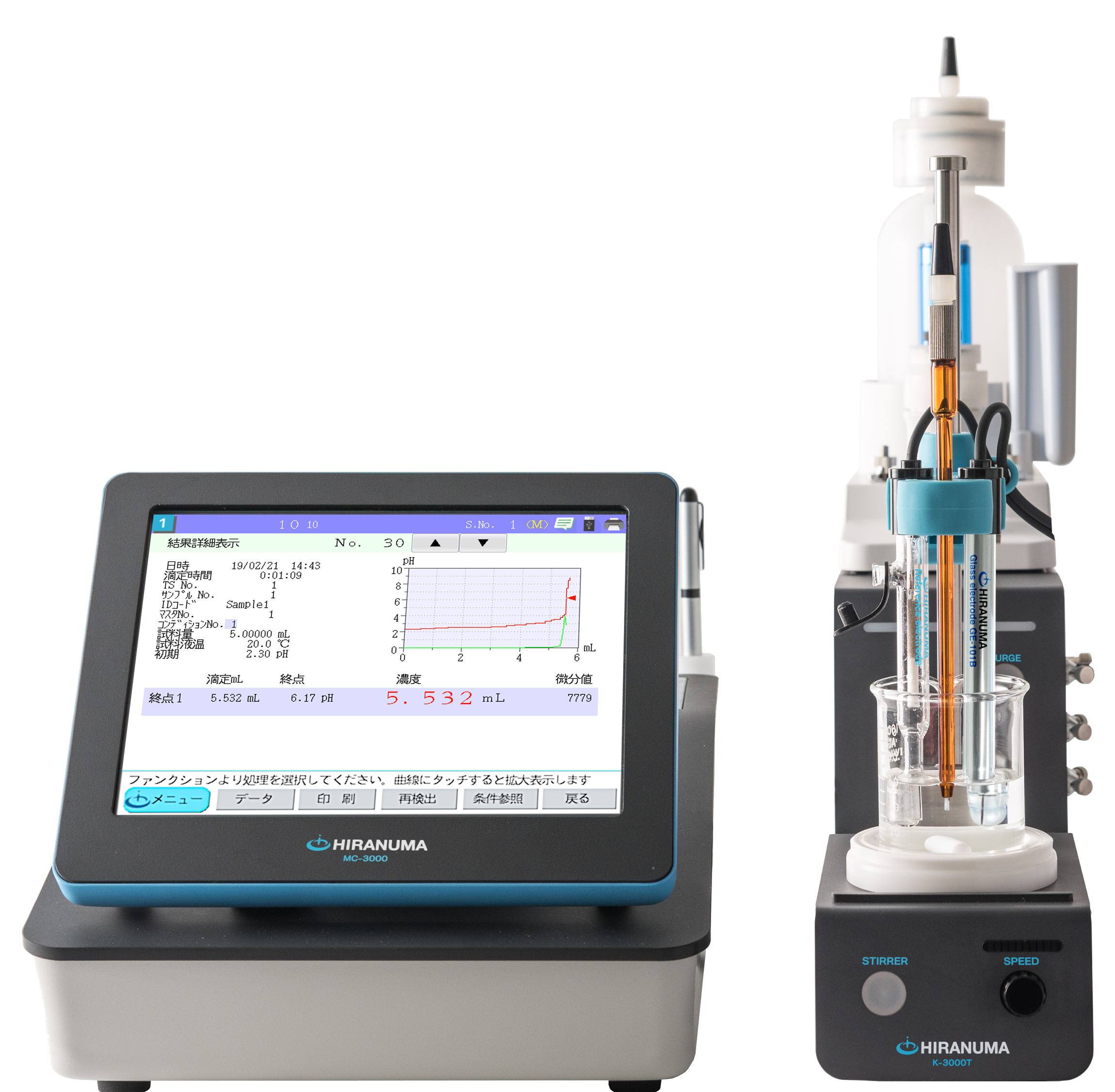
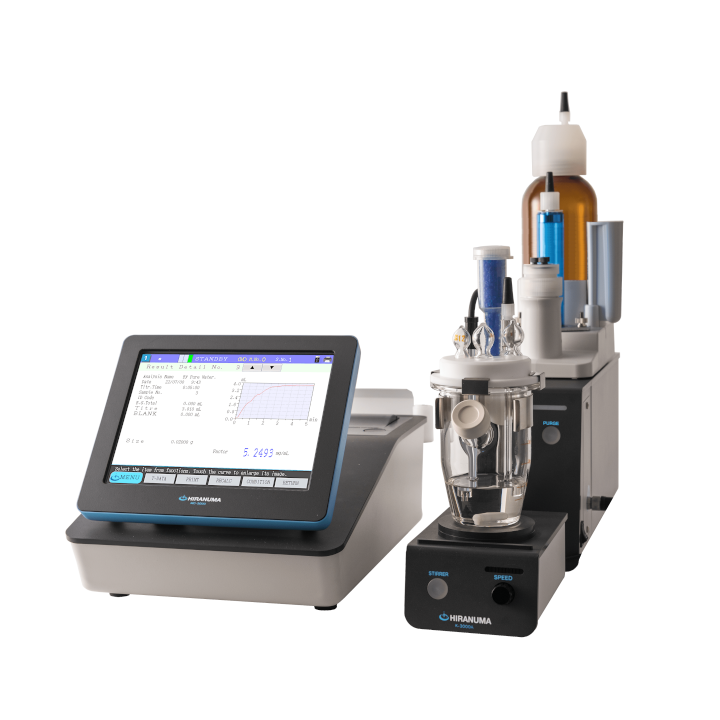
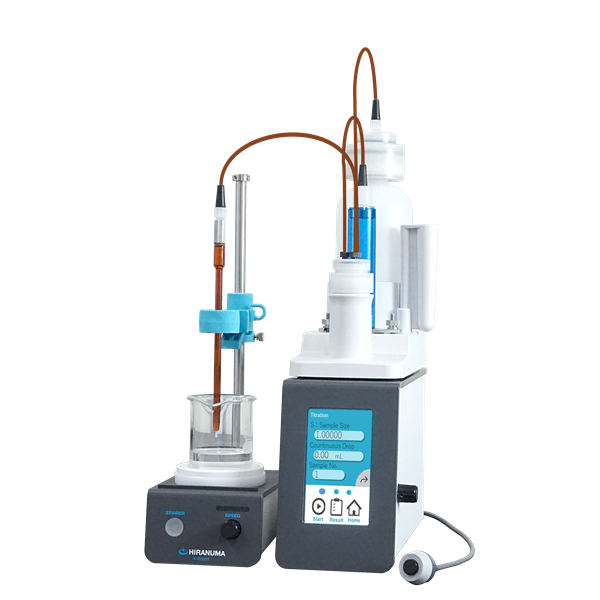
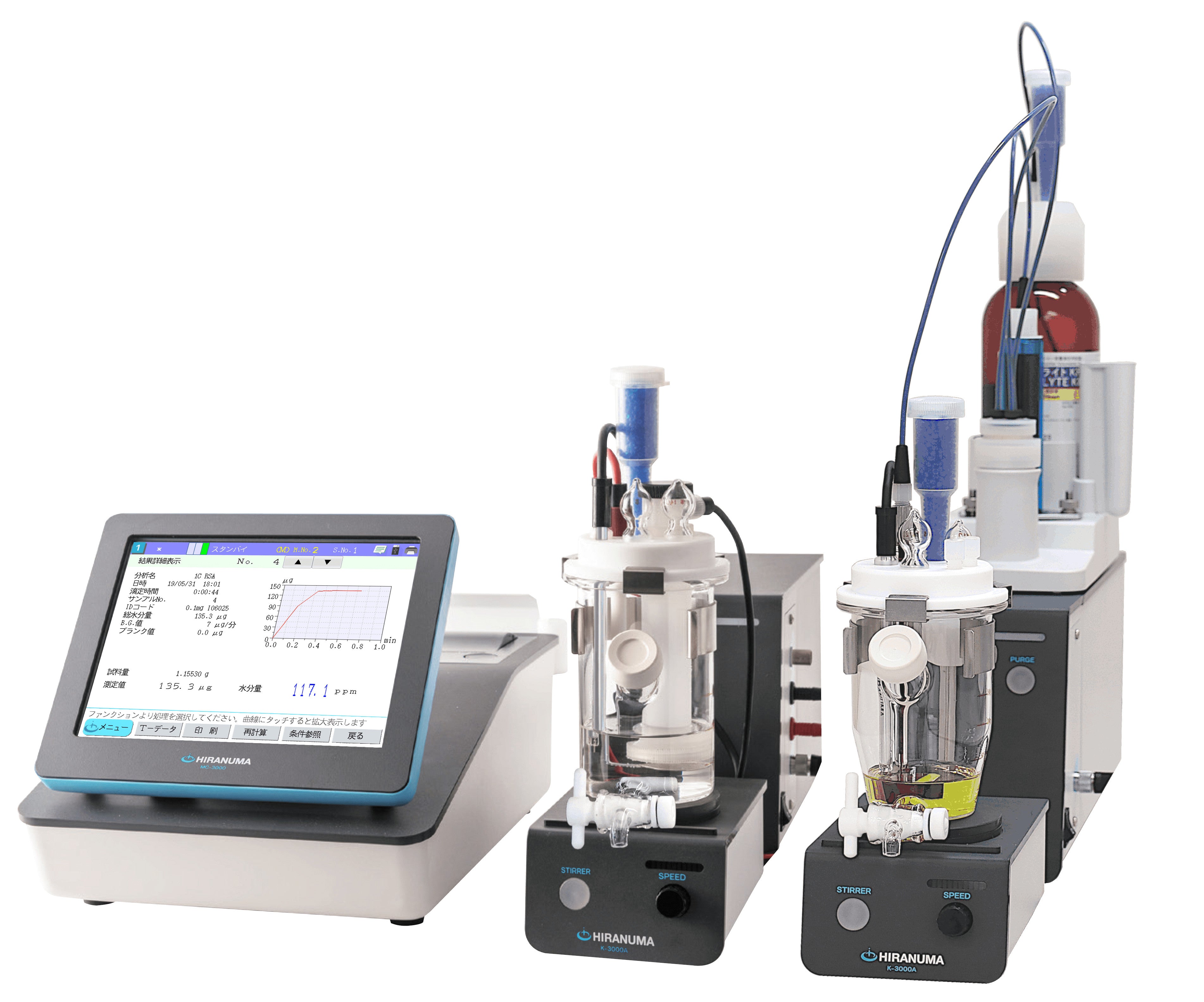
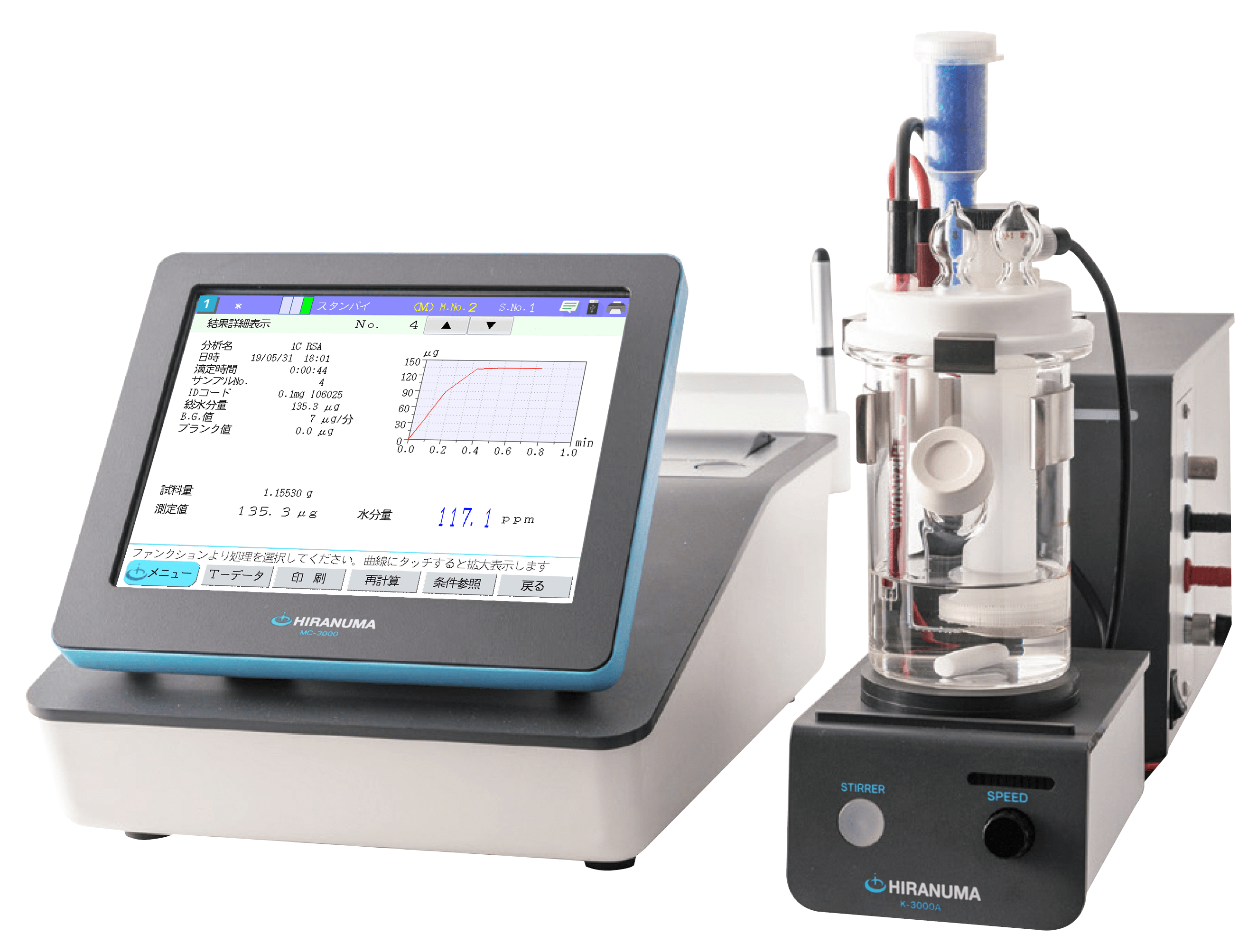
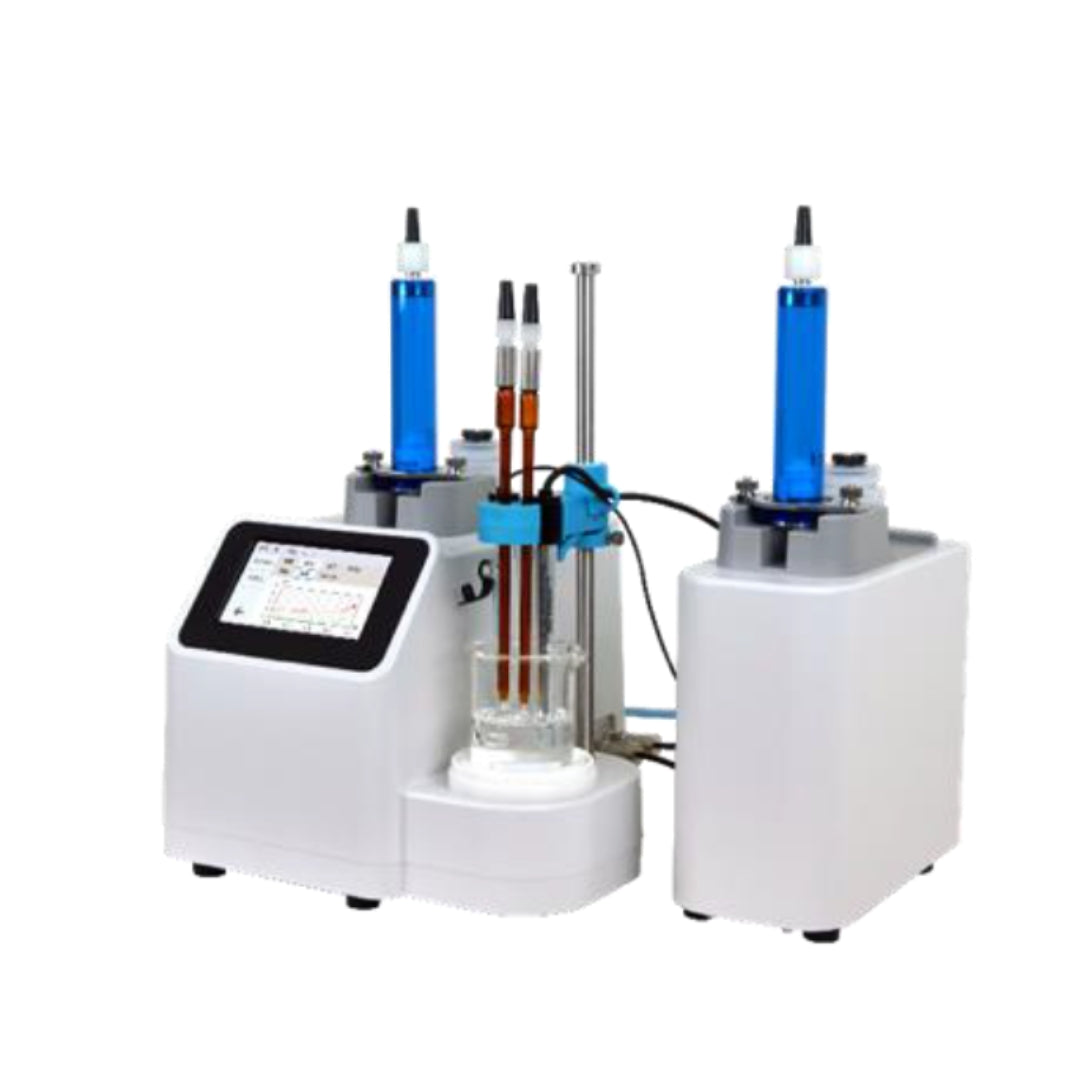
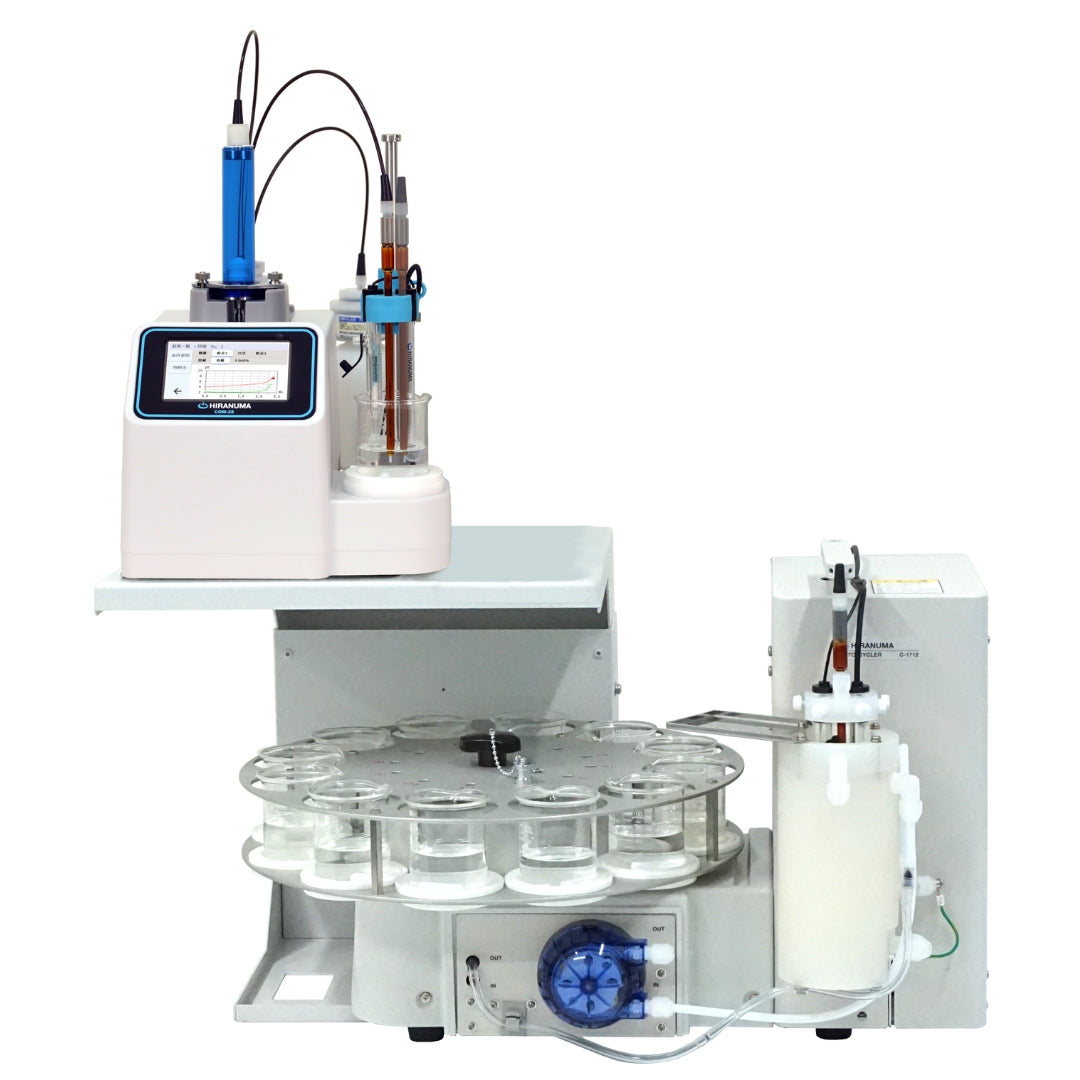
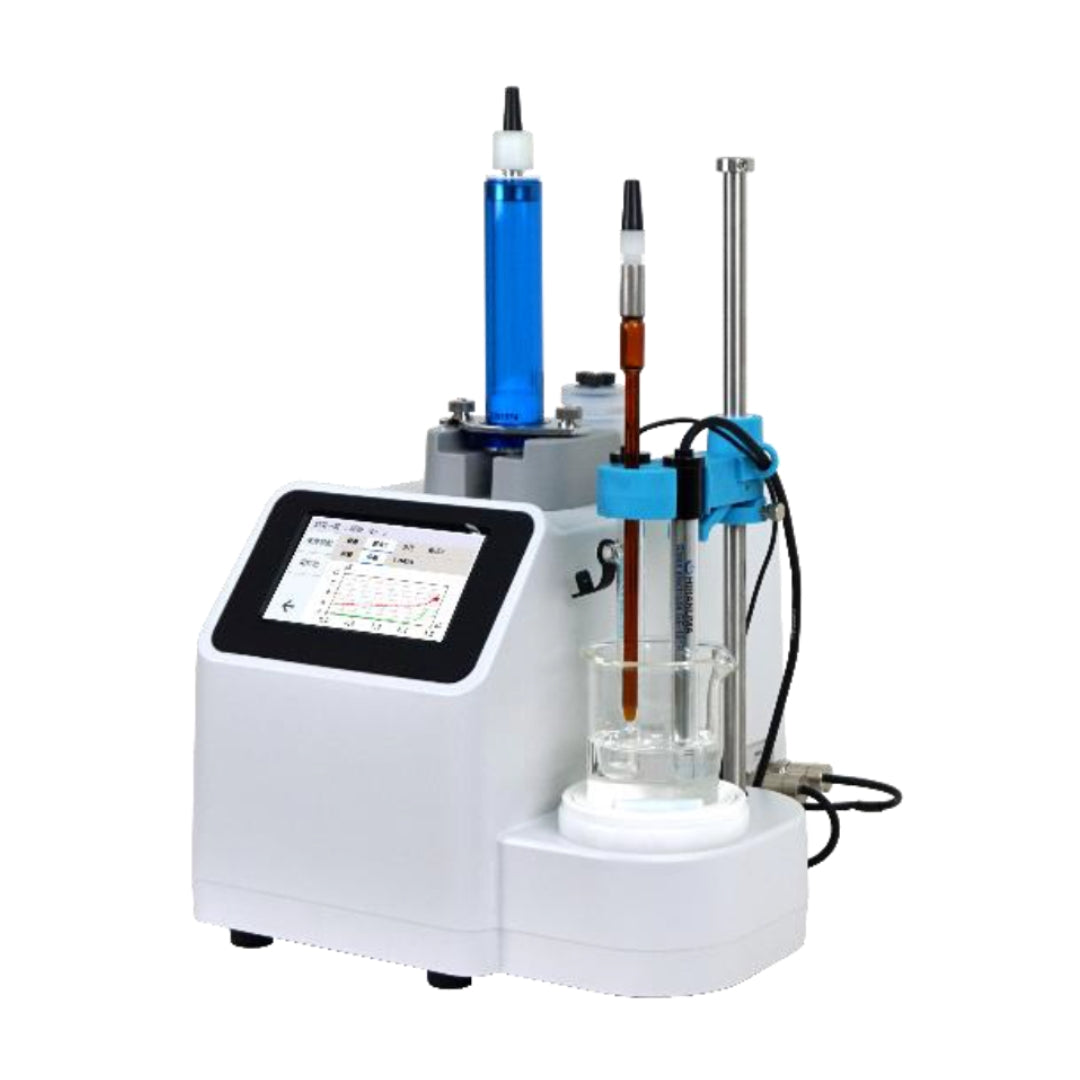
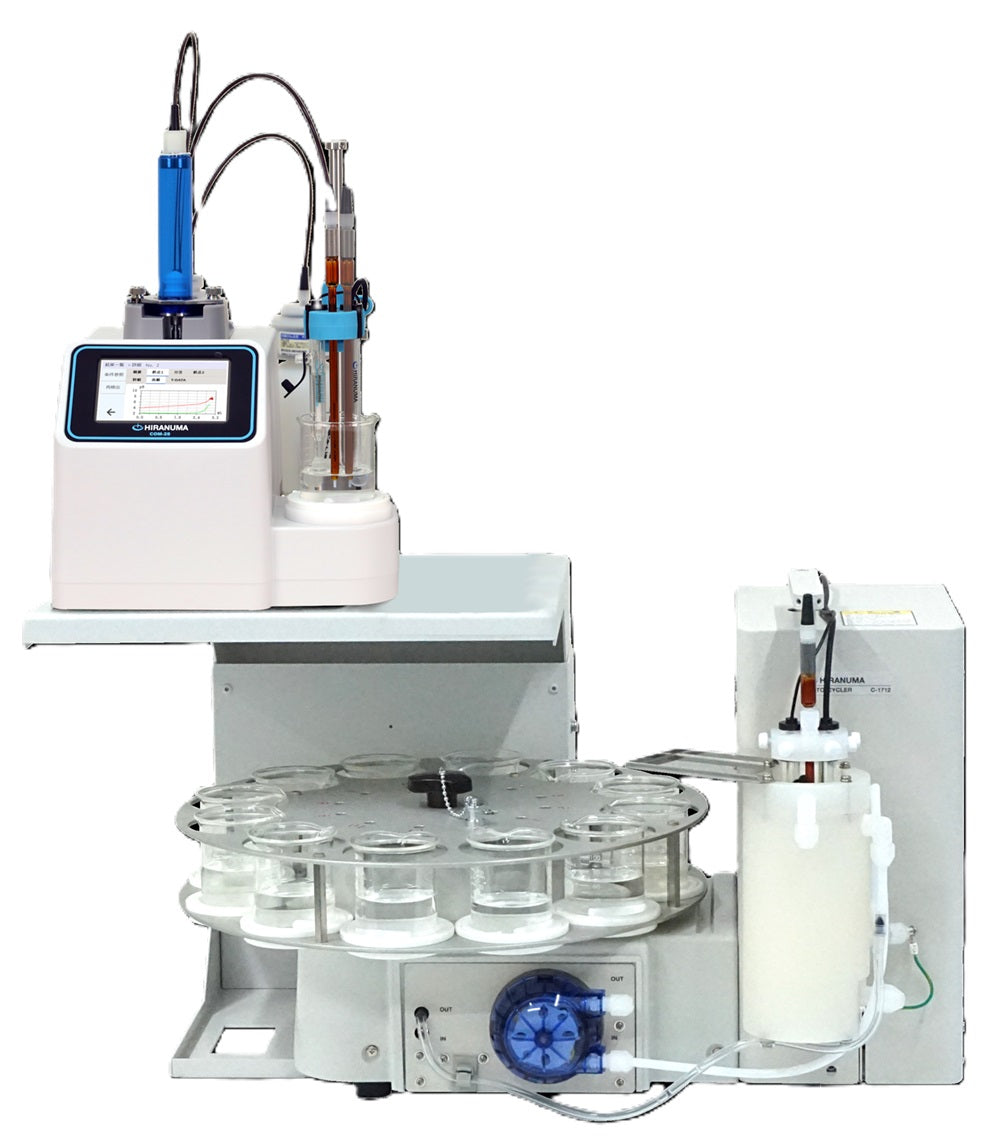
| Main unit | : | Hiranuma Automatic Titrator COM series | |
| Electrodes | : | Glass electrode GE-101B Reference electrode RE-201Z *Instead of the above electrodes, the following electrodes are usable. ・Glass reference combination electrode GR-501BZ…Fixed sleeve type ・Glass reference combination electrode GR-511BZ…Moveable sleeve type |
|
| (2) | Reagents | ||
| Titrant | : | 1 mol/L Sodium hydroxide standard solution | |
3. Measurement procedure
| (1) | Dispense 1 mL of sample into a 100 mL beaker with a volumetric pipette. |
| (2) | Add 40 mL of CO₂-free DI water. |
| (3) | Immerse electrodes and start titration with 1 mol/L sodium hydroxide standard solution. |
4. Measurement conditions and results
Examples of titration conditions
(1) Titration condition for nitric acid
| Cndt No | 1 | |
| Method | Auto | |
| Buret No. | 1 | |
| Amp No. | 1 | |
| D. Unit | pH | |
| S-Timer | 10 | sec |
| C.P. mL | 0 | mL |
| T Timer | 0 | sec |
| D.P. mL | 0 | mL |
| End Sens | 150 | |
| Over mL | 0 | mL |
| Max Vol. | 20 | mL |
| Constant No. | 1 | |
| Size | 1 | mL |
| Blank | 0 | mL |
| Molarity | 1 | mol/L |
| Factor | 1.005 | |
| K | 63.01 | |
| L | 0 | |
| Unit | g/L | |
| Formula | (D-M)*K*F*M/S | |
| Decimal Places | 3 | |
|
Auto In Pram.
|
None | |
| Mode No. | 4 | |
| Pre Int | 0 | sec |
| Del K | 9 | |
| Del Sens | 0 | mV |
| Int Time | 3 | sec |
| Int Sens | 3 | mV |
| Brt Speed | 2 | |
| Pulse | 40 | |
(2) Titration condition for acetic acid
| Cndt No | 2 | |
| Method | Auto | |
| Buret No. | 1 | |
| Amp No. | 1 | |
| D. Unit | pH | |
| S-Timer | 0 | sec |
| C.P. mL | 0 | mL |
| T Timer | 0 | sec |
| D.P. mL | 0 | mL |
| End Sens | 1000 | |
| Over mL | 0.2 | mL |
| Max Vol. | 20 | mL |
| Constant No. | 2 | |
| Size | 1 | mL |
| Blank | 0 | mL |
| Molarity | 1 | mol/L |
| Factor | 1.005 | |
| K | 60.05 | |
| L | 0 | |
| Unit | g/L | |
| Formula | (D-M)*K*F*M/S | |
| Decimal Places | 3 | |
|
Auto In Pram.
|
None | |
| Mode No. | 4 | |
| Pre Int | 0 | sec |
| Del K | 9 | |
| Del Sens | 0 | mV |
| Int Time | 3 | sec |
| Int Sens | 3 | mV |
| Brt Speed | 2 | |
| Pulse | 40 | |
*Connect the condition (1) and (2) for successive titration.
Measurement results
| Number of measurement |
Size (mL) |
Titrant volume at 1st endpoint (mL) |
Nitric acid (g/L) |
Titrant volume at 2nd endpoint (mL) |
Acetic acid (g/L) |
|---|---|---|---|---|---|
| 1 | 1 | 4.708 | 289.134 | 8.314 | 501.752 |
| 2 | 1 | 4.709 | 298.198 | 8.311 | 501.571 |
| 3 | 1 | 4.710 | 298.261 | 8.318 | 501.993 |
| Statistic calculation |
Avg. | 295.2 g/L | Avg. | 501.8 g/L | |
| SD | 5.25 g/L | SD | 0.21 g/L | ||
| RSD | 1.78 % | RSD | 0.04 % | ||
5. Note
・Control of titrant
The concentrated sodium hydroxide standard solution is used as titrant in this report. The carbon dioxide gas absorber (soda lime) on reagent bottle has to be regularly exchanged because sodium hydroxide readily absorbs carbon dioxide gas in the air (formula (3)). The titrant contains sodium carbonate if it absorbed carbon dioxide gas. When using this titrant, the titration curve would show the inflection points at pH around 4 and 9 (formula (4) and (5)).
| 2NaOH + CO₂ → Na₂CO₃ + H₂O | ・・・(3) |
| Na₂CO₃ + HNO₃ → NaHCO₃ + NaNO₃ | ・・・(4) |
| NaHCO₃ + HNO₃ → NaNO₃ + CO₂ + H₂O | ・・・(5) |
Keywords: Nitric acid, Acetic acid, Neutralization titration, Fractional titration, Successive titration
*Some measurement would not be possible depending on optional configuration of system.
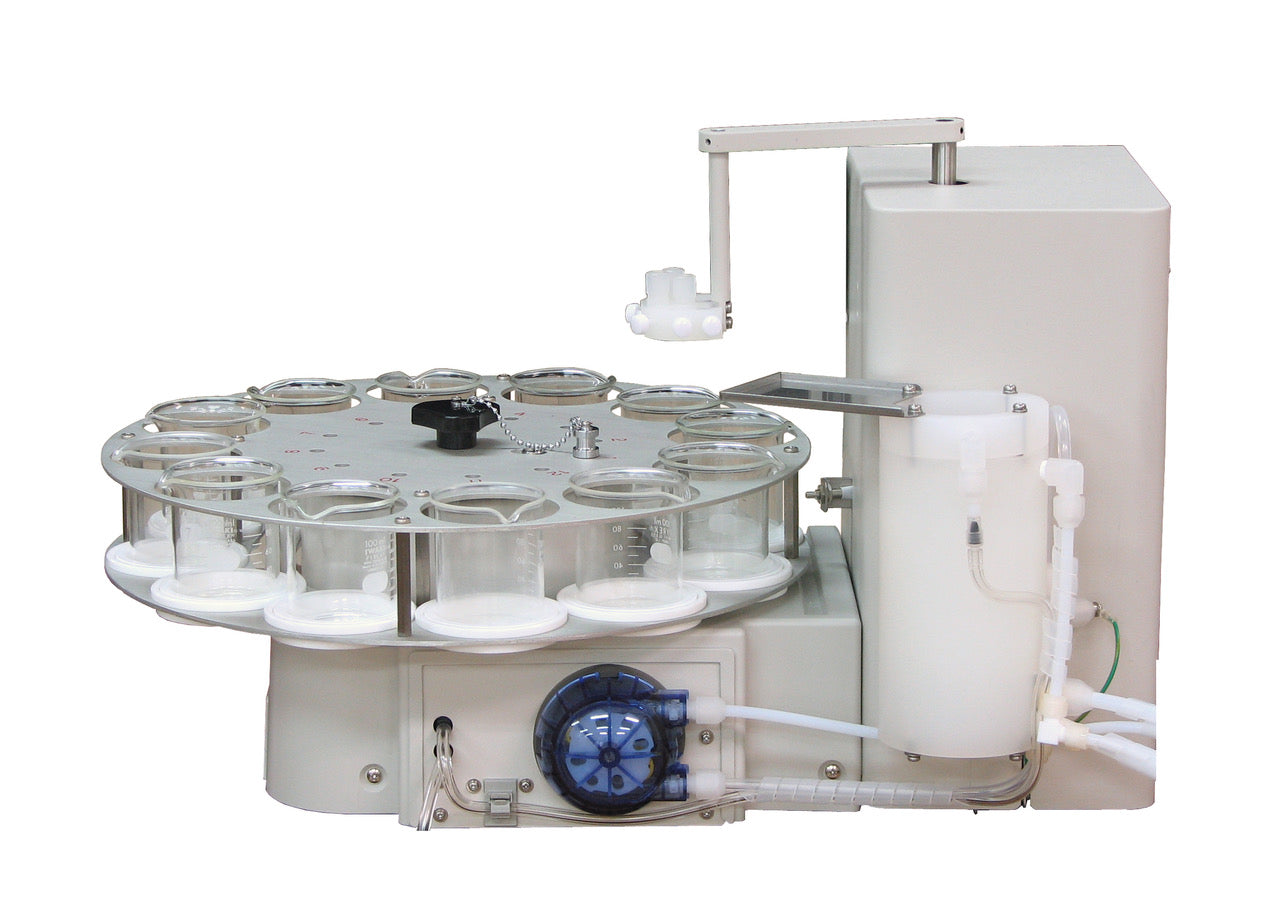
This analysis can be automated using the COM-A19 potentiometric titrator.
Need Help with Mixed Acid Analysis?
JM Science provides automated titration solutions for nitric acid, acetic acid, and other mixed acid systems.
👉 Request a method or discuss your application; sales@jmscience.com; Tel: 716-774-8706